Loading...

Loading...
A practical proof-of-work case study showing how AI can accelerate eLearning design, prototyping, iteration and feedback without removing the need for human judgement.
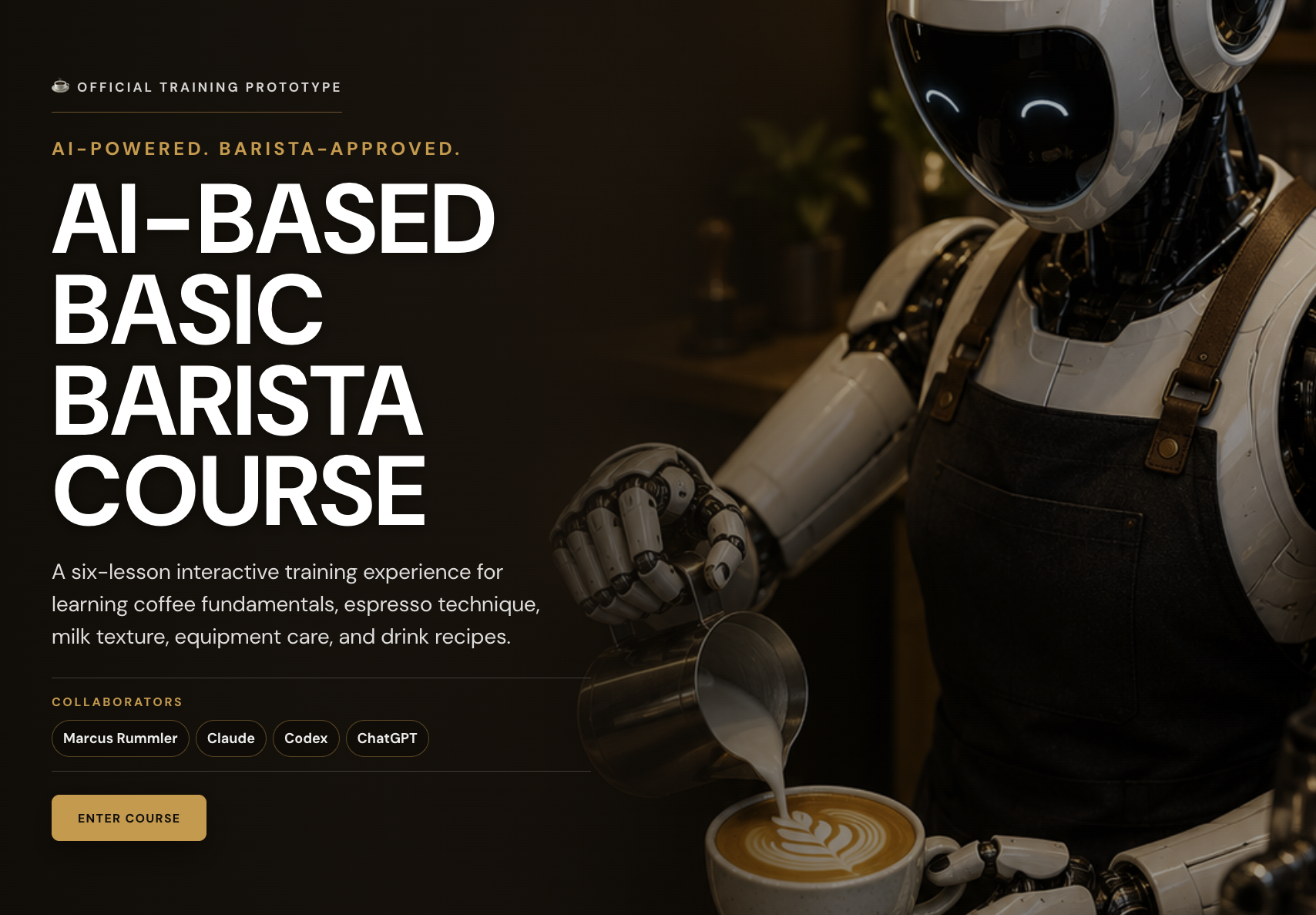
Cover image from the AI-assisted Basic Barista Course prototype.
Format
Interactive eLearning prototype
Built with
Claude, ChatGPT, Codex, Netlify
Role
Prompting, review, ID judgement
Status
Live proof-of-work build
This project began as a prompt and became a live interactive eLearning prototype. Claude helped generate the first working version. ChatGPT supported the visual direction. Codex then reviewed, tested, fixed, extended, packaged and deployed the updated course.
Marcus directed the learning experience, reviewed the output and made the product decisions. The result is a six-lesson interactive barista training course with knowledge checks, visuals, and an AI-powered Espresso Shot Coach.
The real opportunity for AI in learning is not only speeding up content creation. It is creating learning experiences that support practice, feedback and personalised guidance. In this prototype, the Espresso Shot Coach demonstrates how AI can help learners reflect on their own performance and receive coaching-style support after the initial learning experience.
A note on practical skills
For practical skills like coffee-making, real equipment, real practice and human instruction still matter. This prototype is better understood as a refresher, reinforcement tool or post-course support experience, not a replacement for hands-on training.
From initial prompt to deployed course in four key steps.
The learning idea and structure were shaped into a clear AI prompt.
Claude generated the first working version with six interactive lessons, knowledge checks, visuals, diagrams and a rules-based Espresso Shot Coach.
ChatGPT supported the visual direction, including the cover image concept and custom overlay text.
Codex reviewed, tested, fixed, extended, packaged and deployed the updated course to Netlify.
The first version generated interest after being shared publicly, which encouraged further iteration. Here are the improvements made in version two:
Fixed bugs, including invalid shot timer values
Improved mobile experience
Added ChatGPT-generated cover image with custom overlay text
Added certificate of completion
Added final flat white order challenge simulation
Packaged static files and deployed to Netlify
Identified SCORM wrapping as a possible next step
Faster course prototyping
Initial structure and content generation
Interface and interaction ideas
Visual asset support
Code review and improvement
Testing and bug fixing
Packaging and deployment
Faster movement from idea to usable artefact
AI can speed up production, but judgement still determines quality.
Learning flow
Structuring the progression of concepts for effective learning
Accuracy and clarity
Ensuring content is correct and clearly communicated
Tone and learner experience
Maintaining appropriate voice and engagement
Reviewing what AI produced
Evaluating and refining AI-generated outputs
Deciding what was useful
Selecting which AI suggestions to keep or discard
Product decisions
Determining features, scope and direction
Knowing the limits
Understanding where the prototype should not be positioned
“AI does not remove the need for instructional design judgement. It changes where that judgement is applied.”
This project is less about a barista course and more about the changing shape of learning design work.
A single practitioner can now move through roles that previously required a small production team.
AI tools can act as production partners across design, prototyping, visual support, code improvement, testing and deployment.
The human role does not disappear. It moves up a level.
The value is not generic AI content generation. The value is designing practical workflows that turn knowledge into useful outputs.
Many organisations have knowledge trapped in documents, subject matter experts' heads, recordings, SOPs, process notes, policy documents and operational workflows. This workflow shows how AI can help move faster from raw knowledge to structured learning assets.
Convert SME knowledge into draft learning content
Prototype training modules faster
Create job aids and microlearning resources
Build refresher tools after formal training
Add coaching-style support to practice activities
Test learning ideas before investing in full production
Support AI adoption with practical working examples
A live AI-assisted eLearning prototype built from prompt to deployment.
View the live courseThe next logical step would be wrapping the course as SCORM so it can report completion, score and progress inside an LMS. This would move the prototype closer to a workplace learning deployment pattern while keeping the project positioned as a proof-of-work build rather than a commercial client course.
For RETSA Group, this project represents the direction training and workflow design is moving. The opportunity is not to use AI for generic content generation. The opportunity is to design practical workflows where AI helps teams move faster from knowledge to useful outputs.
“AI-assisted course production is starting to feel less like a novelty and more like a practical rapid development workflow.”
Disclaimer: This was a prototype build and proof-of-work project, not a commercial client course or accredited barista qualification.
Help your team adopt AI tools effectively.
Learn moreAutomate repetitive tasks with AI.
Learn moreFull training design services.
Learn moreImprove how training gets done.
Learn moreBuild engaging digital learning.
Learn moreRETSA Group helps teams turn knowledge, processes and ideas into practical training assets, AI-assisted workflows and tools people can actually use.
Start a conversation